8 Rectangles and squares
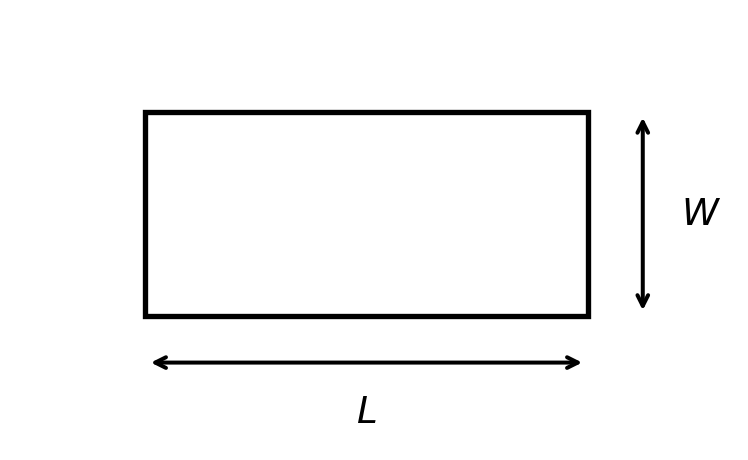
A rectangle is a flat shape with four sides and four right angles. Its two dimensions are the length \(L\) and the width \(W\).
We have two ways to measure the size of a rectangle.
Perimeter (\(P\)) is the distance all the way around the outside of the rectangle — like the length of fencing needed to enclose a field.
Area (\(A\)) is the number of unit squares needed to tile the inside of the rectangle — like the number of floor tiles needed to cover a room.
Perimeter is measured in units of length (feet, meters). Area is measured in square units (square feet, square meters).
8.1 Perimeter
A rectangle has two sides of length \(L\) and two sides of length \(W\), so the perimeter is
\[\text{perimeter} = \text{length} + \text{width} + \text{length} + \text{width} = 2 \cdot \text{length} + 2 \cdot \text{width}\]
\[P = 2L + 2W\]
NoteSquares
A square is a special rectangle where \(L = W\). If we call the common side length \(S\), the perimeter formula simplifies: \[P = 2S + 2S = 4S.\]
For example, a square patio with \(S = 11\) feet has perimeter \(P = 4(11) = 44\) feet.
Example 8.2 (Activity: Marking off park spaces) The town of Red River is laying out two new park spaces.
- Space A is a rectangular picnic area, 20 feet long and 12 feet wide.
- Space B is a square performance stage with side length 15 feet.
- How much rope is needed to mark the boundary of Space A?
- How much rope is needed to mark the boundary of Space B?
TipSolutions
\(P = 2(20) + 2(12) = 40 + 24 = 64\) feet of rope.
\(P = 4(15) = 60\) feet of rope.
8.2 Area
The area of a rectangle is the length multiplied by the width:
\[\text{area} = \text{length} \times \text{width}\]
\[A = L \cdot W\]
NoteSquares
For a square with side length \(S\), the area formula simplifies: \[A = S \cdot S = S^2.\]
For example, a square tile with \(S = 4\) inches has area \(A = 4^2 = 16\) square inches.
Example 8.4 (Activity: Covering the park spaces) Recall the two park spaces from Example 8.2.
- How many square feet of sod are needed to cover Space A?
- How many square feet of paving stones are needed for Space B?
- What is the total area of both spaces combined?
TipSolutions
\(A = 20 \cdot 12 = 240\) square feet.
\(A = 15^2 = 225\) square feet.
\(240 + 225 = 465\) square feet total.
8.3 Practice: perimeter and area
Example 8.5 (Activity: Computing perimeter and area) Complete the following table. The first row is completed for you as a reference.
| \(L\) | \(W\) | \(P = 2L + 2W\) | \(A = L \cdot W\) |
|---|---|---|---|
| 14 ft | 10 ft | 48 ft | 140 sq ft |
| 9 ft | 5 ft | ||
| 20 ft | 8 ft | ||
| 6 ft | 6 ft | ||
| 7 ft | 3 ft | ||
| 12 ft | 12 ft | ||
| 4.5 ft | 8 ft |
Note: rows 4 and 6 are squares.
TipSolutions
| \(L\) | \(W\) | \(P\) | \(A\) |
|---|---|---|---|
| 14 ft | 10 ft | 48 ft | 140 sq ft |
| 9 ft | 5 ft | 28 ft | 45 sq ft |
| 20 ft | 8 ft | 56 ft | 160 sq ft |
| 6 ft | 6 ft | 24 ft | 36 sq ft |
| 7 ft | 3 ft | 20 ft | 21 sq ft |
| 12 ft | 12 ft | 48 ft | 144 sq ft |
| 4.5 ft | 8 ft | 25 ft | 36 sq ft |
8.4 Finding a missing dimension
So far we have computed \(P\) and \(A\) when both \(L\) and \(W\) are given. We can also run this process in reverse: if we know the area or perimeter and one dimension, we can set up an equation and solve for the missing dimension. This is the same equation-solving process from the previous chapter, now applied to geometry.
Example 8.8 (Activity: Rectangle problems) For each problem, identify which formula to use, set up the equation, and solve.
- A classroom at UNM-Taos is 32 feet long. The room requires 864 square feet of new flooring. How wide is the classroom?
- Maria is planting a rectangular vegetable garden at the Taos Farmers Market. She has 52 feet of fencing and wants the garden to be 16 feet long. How wide can the garden be?
- A rancher near Cimarron wants to build a rectangular horse corral. The corral will be 45 feet wide, and 200 feet of fencing is available. How long can the corral be?
- A square tile used at a Taos Pueblo art market has an area of 81 square inches. What is the side length of the tile? (Hint: what number times itself equals 81?)
TipSolutions
\(A = L \cdot W\), so \(864 = 32 \cdot W\). Dividing both sides by 32: \(W = 27\) feet.
\(P = 2L + 2W\), so \(52 = 2(16) + 2W \Rightarrow 52 = 32 + 2W \Rightarrow 20 = 2W \Rightarrow W = 10\) feet.
\(P = 2L + 2W\), so \(200 = 2L + 2(45) \Rightarrow 200 = 2L + 90 \Rightarrow 110 = 2L \Rightarrow L = 55\) feet.
\(A = S^2\), so \(S^2 = 81\). Since \(9 \cdot 9 = 81\), the side length is \(S = 9\) inches.
Example 8.9 (Activity: Missing dimensions) Complete the following table. Some entries are given; find the rest. For the last two rows the rectangle is a square (\(L = W = S\)): find \(S\) first, then complete the row.
| \(L\) | \(W\) | \(P = 2L + 2W\) | \(A = L \cdot W\) |
|---|---|---|---|
| 8 | ? | 56 | |
| ? | 5 | 60 | |
| 15 | ? | 46 | |
| ? | 6 | 40 | |
| \(S\) | \(S\) | 64 | |
| \(S\) | \(S\) | 36 |
TipSolutions
Row 1: \(8 \cdot W = 56 \Rightarrow W = 7\). Then \(P = 2(8) + 2(7) = 30\).
Row 2: \(L \cdot 5 = 60 \Rightarrow L = 12\). Then \(P = 2(12) + 2(5) = 34\).
Row 3: \(2(15) + 2W = 46 \Rightarrow 30 + 2W = 46 \Rightarrow W = 8\). Then \(A = 15 \cdot 8 = 120\).
Row 4: \(2L + 2(6) = 40 \Rightarrow 2L + 12 = 40 \Rightarrow 2L = 28 \Rightarrow L = 14\). Then \(A = 14 \cdot 6 = 84\).
Row 5: \(S^2 = 64\). Since \(8 \cdot 8 = 64\), \(S = 8\). Then \(P = 4(8) = 32\).
Row 6: \(4S = 36 \Rightarrow S = 9\). Then \(A = 9^2 = 81\).
8.5 Square roots
In the missing dimension problems above, the last two rows involved a square where we knew the area \(A\) and needed to find the side length \(S\). This means solving \(S^2 = A\) — finding a number that, when multiplied by itself, gives \(A\).
This operation is called taking the square root of \(A\), written \(\sqrt{A}\): \[\sqrt{A} = S \quad \text{means} \quad S \cdot S = A.\]
The table below lists the square roots of the first several perfect squares — numbers whose square root is a whole number.
| \(A\) | \(\sqrt{A}\) | \(A\) | \(\sqrt{A}\) | |
|---|---|---|---|---|
| 1 | 1 | 49 | 7 | |
| 4 | 2 | 64 | 8 | |
| 9 | 3 | 81 | 9 | |
| 16 | 4 | 100 | 10 | |
| 25 | 5 | 121 | 11 | |
| 36 | 6 | 144 | 12 |
For areas that are not perfect squares, \(\sqrt{A}\) is not a whole number. In those cases, use the \(\sqrt{\phantom{x}}\) button on your calculator.
Example 8.11 (Activity: Finding side lengths from area) For each square, find the side length \(S\).
- A square has area 49 square feet. What is \(S\)?
- A square has area 144 square meters. What is \(S\)?
- A square courtyard has area 225 square feet. What is \(S\)? (Hint: try \(S = 15\).)
- A square patio has area 75 square feet. What is \(S\)? Use a calculator and round to two decimal places.
TipSolutions
\(\sqrt{49} = 7\) feet, since \(7 \cdot 7 = 49\).
\(\sqrt{144} = 12\) meters, since \(12 \cdot 12 = 144\).
\(\sqrt{225} = 15\) feet, since \(15 \cdot 15 = 225\).
\(\sqrt{75} \approx 8.66\) feet.
8.6 Homework exercises
Exercise 8.1 For each problem, identify which formula to use, set up the equation, and solve.
- A rectangular storage unit in Taos is 9 feet wide and has a floor area of 108 square feet. How long is the storage unit?
- The Taos County Fair is setting up a rectangular exhibition space. The space is 60 feet long, and 220 feet of rope is available to mark the boundary. How wide can the exhibition space be?
- A square room at the UNM-Taos student center has a perimeter of 56 feet. What is the area of the room?
- A rancher near Abiquiú wants to build a rectangular sheep pen. The pen is 25 feet long, and 110 feet of fencing is available. How wide is the pen? What is the area of the pen?
TipSolutions
\(A = L \cdot W\), so \(108 = L \cdot 9\). Dividing both sides by 9: \(L = 12\) feet.
\(P = 2L + 2W\), so \(220 = 2(60) + 2W \Rightarrow 220 = 120 + 2W \Rightarrow 100 = 2W \Rightarrow W = 50\) feet.
\(P = 4S = 56 \Rightarrow S = 14\) feet. Then \(A = 14^2 = 196\) square feet.
\(P = 2L + 2W\), so \(110 = 2(25) + 2W \Rightarrow 110 = 50 + 2W \Rightarrow 60 = 2W \Rightarrow W = 30\) feet. The area is \(A = 25 \cdot 30 = 750\) square feet.
Exercise 8.2 Complete the following table. Some entries are given; find the rest. For the last two rows the rectangle is a square (\(L = W = S\)): find \(S\) first, then complete the row.
| \(L\) | \(W\) | \(P = 2L + 2W\) | \(A = L \cdot W\) |
|---|---|---|---|
| 11 | 4 | ||
| 6 | ? | 48 | |
| ? | 7 | 84 | |
| 20 | ? | 62 | |
| ? | 9 | 50 | |
| \(S\) | \(S\) | 100 | |
| \(S\) | \(S\) | 44 |
TipSolutions
Row 1: \(P = 2(11) + 2(4) = 30\). \(A = 11 \cdot 4 = 44\).
Row 2: \(6 \cdot W = 48 \Rightarrow W = 8\). Then \(P = 2(6) + 2(8) = 28\).
Row 3: \(L \cdot 7 = 84 \Rightarrow L = 12\). Then \(P = 2(12) + 2(7) = 38\).
Row 4: \(2(20) + 2W = 62 \Rightarrow 40 + 2W = 62 \Rightarrow W = 11\). Then \(A = 20 \cdot 11 = 220\).
Row 5: \(2L + 2(9) = 50 \Rightarrow 2L + 18 = 50 \Rightarrow 2L = 32 \Rightarrow L = 16\). Then \(A = 16 \cdot 9 = 144\).
Row 6: \(S^2 = 100\). Since \(10 \cdot 10 = 100\), \(S = 10\). Then \(P = 4(10) = 40\).
Row 7: \(4S = 44 \Rightarrow S = 11\). Then \(A = 11^2 = 121\).