11 Rectangular Boxes
A rectangular box (also called a rectangular prism) is a solid shape with six flat, rectangular faces. Think of a shoebox, a brick, or a room. Every corner is a right angle.
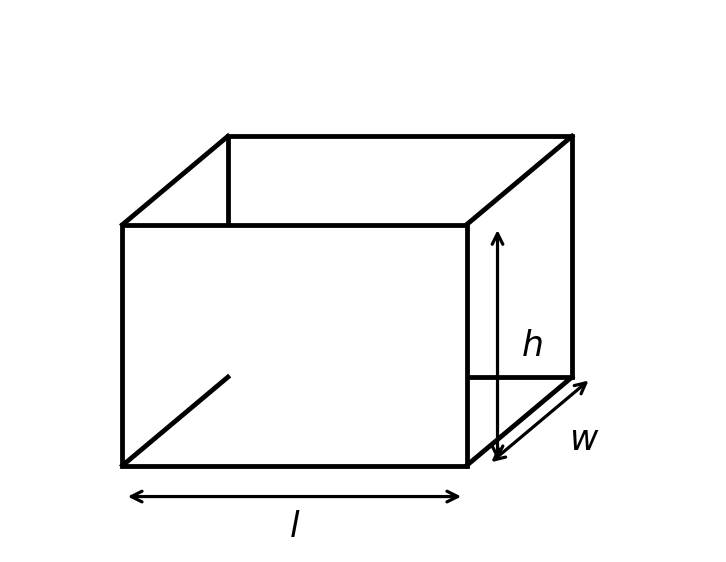
A rectangular box has three dimensions:
- Length \(l\) — the longest horizontal dimension
- Width \(w\) — the shorter horizontal dimension
- Height \(h\) — the vertical dimension
11.1 Volume
Volume measures how much three-dimensional space a solid occupies. It is measured in cubic units — cubic inches, cubic feet, cubic centimeters, and so on.
The volume of a rectangular box is: \[V = l \cdot w \cdot h.\]
You can think of it as stacking layers: each layer has area \(l \cdot w\), and there are \(h\) layers.
Example 11.2 (Activity: Computing volume) For each box, find the volume. Include units in your answer.
- A cardboard shipping box is 18 inches long, 12 inches wide, and 10 inches tall.
- A raised garden bed at the UNM-Taos community garden is 8 feet long, 4 feet wide, and 1.5 feet deep. How many cubic feet of soil does it hold?
- A refrigerator interior measures 2.5 feet wide, 2 feet deep, and 5 feet tall. What is the volume?
TipSolutions
\(V = 18 \cdot 12 \cdot 10 = 2{,}160\) cubic inches.
\(V = 8 \cdot 4 \cdot 1.5 = 48\) cubic feet.
\(V = 2.5 \cdot 2 \cdot 5 = 25\) cubic feet.
11.2 Surface area
Surface area is the total area of all six faces of the box. Think of it as the amount of wrapping paper needed to cover the outside of a box.
A rectangular box has three pairs of opposite faces:
- Two faces of size \(l \times h\) (front and back)
- Two faces of size \(l \times w\) (top and bottom)
- Two faces of size \(w \times h\) (left and right)
The total surface area is: \[SA = 2lh + 2lw + 2wh.\]
Example 11.4 (Activity: Computing surface area) For each box, find the surface area. Include units in your answer.
- The shipping box from the previous activity: 18 inches long, 12 inches wide, 10 inches tall.
- A jewelry box at a Taos gallery measures 8 inches long, 5 inches wide, and 3 inches tall. How many square inches of material are needed to make the box?
- A classroom at UNM-Taos is 30 feet long, 24 feet wide, and 9 feet tall. What is the total surface area of the walls, floor, and ceiling?
TipSolutions
\(SA = 2(18)(10) + 2(18)(12) + 2(12)(10) = 360 + 432 + 240 = 1{,}032\) square inches.
\(SA = 2(8)(3) + 2(8)(5) + 2(5)(3) = 48 + 80 + 30 = 158\) square inches.
\(SA = 2(30)(9) + 2(30)(24) + 2(24)(9) = 540 + 1{,}440 + 432 = 2{,}412\) square feet.
11.3 Practice: volume and surface area
Example 11.5 (Activity: Computing volume and surface area) Complete the table. Round all answers to two decimal places.
| \(l\) | \(w\) | \(h\) | \(V = lwh\) | \(SA = 2lh+2lw+2wh\) |
|---|---|---|---|---|
| 4 ft | 3 ft | 2 ft | ||
| 10 ft | 5 ft | 6 ft | ||
| 7 in | 7 in | 7 in | ||
| 12 cm | 8 cm | 3 cm | ||
| 6 m | 2.5 m | 4 m |
TipSolutions
| \(l\) | \(w\) | \(h\) | \(V\) | \(SA\) |
|---|---|---|---|---|
| 4 ft | 3 ft | 2 ft | 24 cu ft | 52 sq ft |
| 10 ft | 5 ft | 6 ft | 300 cu ft | 280 sq ft |
| 7 in | 7 in | 7 in | 343 cu in | 294 sq in |
| 12 cm | 8 cm | 3 cm | 288 cu cm | 312 sq cm |
| 6 m | 2.5 m | 4 m | 60 cu m | 128 sq m |
11.4 Finding a missing dimension
If the volume and two dimensions are known, we can solve for the third dimension. Start from \(V = l \cdot w \cdot h\) and divide both sides by the known dimensions.
Example 11.7 (Activity: Finding missing dimensions) For each problem, set up an equation and solve for the missing dimension.
- A fish tank has a volume of 360 cubic inches. It is 15 inches long and 8 inches wide. What is its height?
- A sandbox at a Taos park has a volume of 48 cubic feet. It is 8 feet long and 2 feet deep. What is the width?
- A box of tiles at a Taos hardware store has a volume of 1,200 cubic centimeters. The box is 20 cm long and 10 cm wide. How tall is the box?
TipSolutions
\(360 = 15 \cdot 8 \cdot h \Rightarrow 360 = 120h \Rightarrow h = 3\) inches.
\(48 = 8 \cdot w \cdot 2 \Rightarrow 48 = 16w \Rightarrow w = 3\) feet.
\(1{,}200 = 20 \cdot 10 \cdot h \Rightarrow 1{,}200 = 200h \Rightarrow h = 6\) centimeters.
11.5 Homework exercises
Exercise 11.1 For each problem, set up an equation and solve. Round to two decimal places where needed.
- A chest freezer at a Taos grocery store measures 5 feet long, 2.5 feet wide, and 3 feet tall. What is the volume of the freezer? What is the surface area?
- A rectangular swimming pool at a Taos resort is 25 feet long, 12 feet wide, and 4 feet deep. How many cubic feet of water does the pool hold when full?
- A gift box is 14 inches long, 9 inches wide, and 4 inches tall. How many square inches of wrapping paper are needed to cover it exactly?
- A rectangular water tank has a volume of 240 cubic feet. The tank is 10 feet long and 4 feet wide. What is the height of the tank?
TipSolutions
\(V = 5 \cdot 2.5 \cdot 3 = 37.5\) cubic feet. \(SA = 2(5)(3) + 2(5)(2.5) + 2(2.5)(3) = 30 + 25 + 15 = 70\) square feet.
\(V = 25 \cdot 12 \cdot 4 = 1{,}200\) cubic feet.
\(SA = 2(14)(4) + 2(14)(9) + 2(9)(4) = 112 + 252 + 72 = 436\) square inches.
\(240 = 10 \cdot 4 \cdot h \Rightarrow 240 = 40h \Rightarrow h = 6\) feet.
Exercise 11.2 Complete the table. Round all answers to two decimal places. For rows where the volume and two dimensions are given, find the missing dimension first.
| \(l\) | \(w\) | \(h\) | \(V = lwh\) | \(SA = 2lh+2lw+2wh\) |
|---|---|---|---|---|
| 5 ft | 4 ft | 3 ft | ||
| 8 ft | 6 ft | 288 cu ft | ||
| 9 in | 4 in | 180 cu in | ||
| 3 m | 5 m | 120 cu m | ||
| 7 cm | 7 cm | 7 cm | ||
| 12 ft | 10 ft | 8 ft |
TipSolutions
Row 1: \(V = 5 \cdot 4 \cdot 3 = 60\) cu ft. \(SA = 2(5)(3)+2(5)(4)+2(4)(3) = 30+40+24 = 94\) sq ft.
Row 2: \(h = 288 \div (8 \cdot 6) = 6\) ft. \(SA = 2(8)(6)+2(8)(6)+2(6)(6) = 96+96+72 = 264\) sq ft.
Row 3: \(w = 180 \div (9 \cdot 4) = 5\) in. \(SA = 2(9)(4)+2(9)(5)+2(5)(4) = 72+90+40 = 202\) sq in.
Row 4: \(l = 120 \div (3 \cdot 5) = 8\) m. \(SA = 2(8)(5)+2(8)(3)+2(3)(5) = 80+48+30 = 158\) sq m.
Row 5: \(V = 7 \cdot 7 \cdot 7 = 343\) cu cm. \(SA = 6 \cdot 7^2 = 294\) sq cm.
Row 6: \(V = 12 \cdot 10 \cdot 8 = 960\) cu ft. \(SA = 2(12)(8)+2(12)(10)+2(10)(8) = 192+240+160 = 592\) sq ft.