10 Right Triangles and the Pythagorean Theorem
NoteVocabulary: right triangles
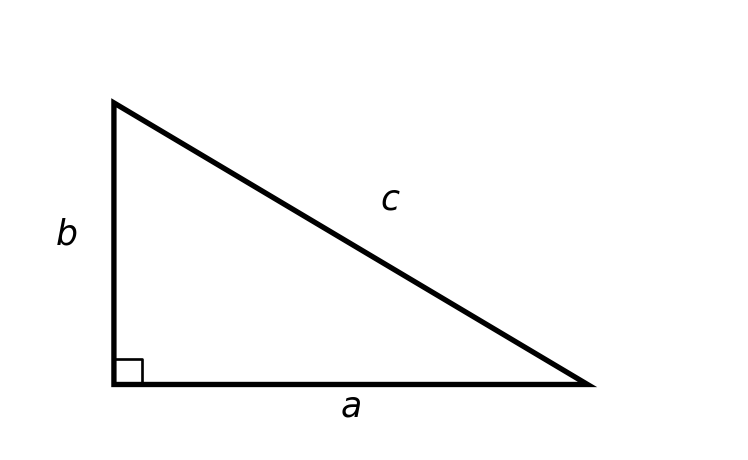
A right triangle is a triangle with one right angle (a 90° corner). The two sides that form the right angle are the legs. The side opposite the right angle — always the longest side — is the hypotenuse.
10.1 Area of a right triangle
The key observation is that every right triangle fits exactly inside a rectangle. The two legs of the triangle become the sides of the rectangle, and the remaining corner of the rectangle completes the shape.
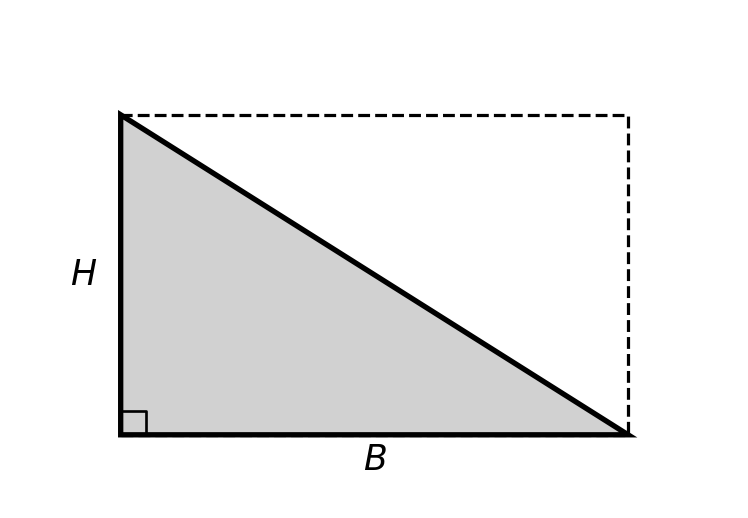
Because the diagonal cuts the rectangle into two identical triangles, the right triangle takes up exactly half the rectangle’s area.
In general, if the two legs of a right triangle have lengths \(B\) and \(H\): \[A = \dfrac{1}{2} \cdot B \cdot H.\]
NoteBase, height, and legs
For a right triangle, the two legs are perpendicular to each other, so either leg can serve as the base and the other as the height.
Example 10.2 (Activity: Area of right triangles) Draw a picture of each triangle and find the area.
- Legs: 3 ft and 4 ft.
- Legs: 5 ft and 12 ft.
- Legs: 8 ft and 15 ft.
- A triangular section of a garden plot at the Taos Farmers Market has legs of 9 feet and 6 feet. What is the area of the plot?
TipSolutions
\(A = \dfrac{1}{2}(3)(4) = 6\) square feet.
\(A = \dfrac{1}{2}(5)(12) = 30\) square feet.
\(A = \dfrac{1}{2}(8)(15) = 60\) square feet.
\(A = \dfrac{1}{2}(9)(6) = 27\) square feet.
10.2 The Pythagorean Theorem
The legs and hypotenuse of a right triangle are connected by a remarkable relationship. We will discover this relationship through a geometric argument.
Discovering the theorem
Start with a large square whose side length equals the sum of the two legs of our right triangle. Place four copies of the right triangle in the corners of the square, each pointing inward. The four triangles leave a smaller tilted square in the middle.
The figure below shows this construction for a right triangle with legs 3 and 4.
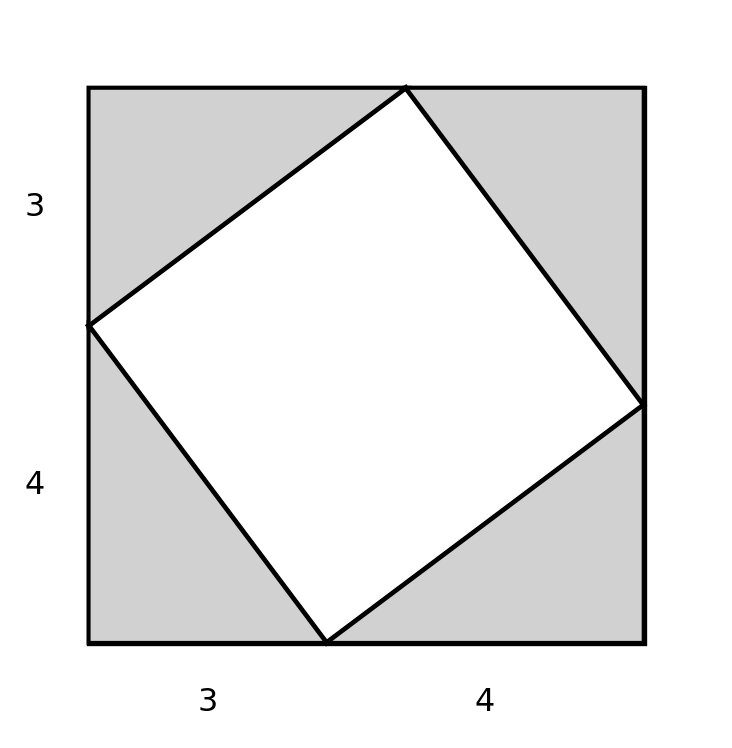
Example 10.3 (Activity: Discovering the Pythagorean Theorem) Use the figure above. The large square has side \(3 + 4 = 7\).
- What is the area of the large square?
- Each shaded right triangle has legs 3 and 4. What is the area of one triangle? What is the combined area of all four triangles?
- Subtract the four triangles from the large square. What is the area of the inner tilted square?
- What is the side length of the inner square? (Use a square root.)
- The side of the inner square is the hypotenuse of each right triangle. Compute \(3^2 + 4^2\). What do you notice?
TipSolutions
\(7^2 = 49\).
One triangle: \(\dfrac{1}{2}(3)(4) = 6\). Four triangles: \(4 \cdot 6 = 24\).
\(49 - 24 = 25\) square units.
\(\sqrt{25} = 5\) units.
\(3^2 + 4^2 = 9 + 16 = 25 = 5^2\). The sum of the squares of the legs equals the square of the hypotenuse.
But why does \(3^2 + 4^2\) give exactly the same answer as \(c^2\)? A second way of subdividing the same big square explains why. Draw a vertical line at distance 3 from the left and a horizontal line at distance 3 from the bottom.
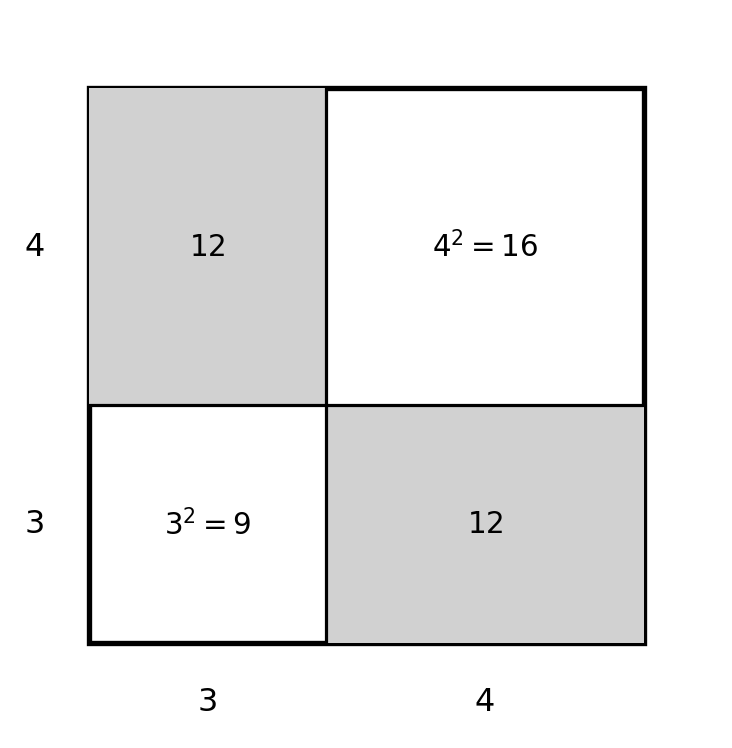
This subdivision shows the big square as two smaller squares (\(3^2 = 9\) and \(4^2 = 16\), shown white) and two rectangles (each \(3 \cdot 4 = 12\), shown gray). Both diagrams include the same gray area — four triangles in the first diagram, two rectangles in the second — each totaling 24. Since the total area is the same in both diagrams:
\[c^2 + 24 = 9 + 16 + 24 \qquad \Rightarrow \qquad c^2 = 9 + 16 = 3^2 + 4^2.\]
The general argument
The same two diagrams work for any right triangle with legs \(a\) and \(b\) and hypotenuse \(c\).
- Diagram 1 shows the tilted inner square (area \(c^2 + 2ab\));
- Diagram 2 shows the axis-aligned subdivision (area \(a^2 + b^2 + 2ab\)).
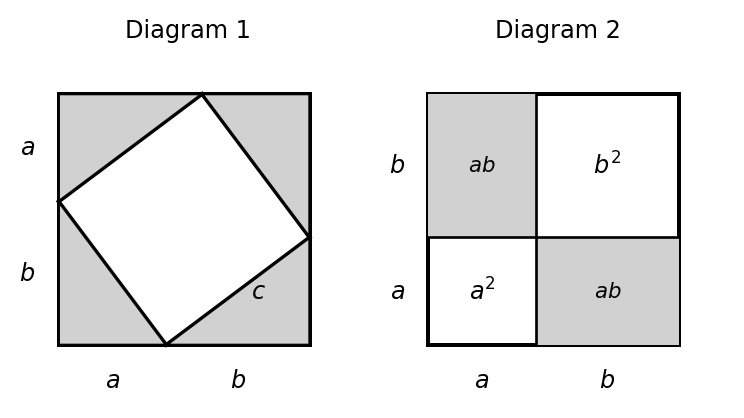
Both diagrams describe the same large square, so their areas are equal: \[c^2 + 2ab = a^2 + b^2 + 2ab.\] Subtracting \(2ab\) from both sides gives the Pythagorean Theorem:
\[\boxed{a^2 + b^2 = c^2}\]
where \(a\) and \(b\) are the legs and \(c\) is the hypotenuse of any right triangle.
10.3 Finding missing sides
Finding the hypotenuse
If both legs are known, square them, add, and take the square root.
Finding a leg
If the hypotenuse and one leg are known, rearrange \(a^2 + b^2 = c^2\) to isolate the unknown leg.
Example 10.6 (Activity: Finding missing sides) Diagrams are provided for problems 1 and 2. Draw your own diagram for problems 3–5.
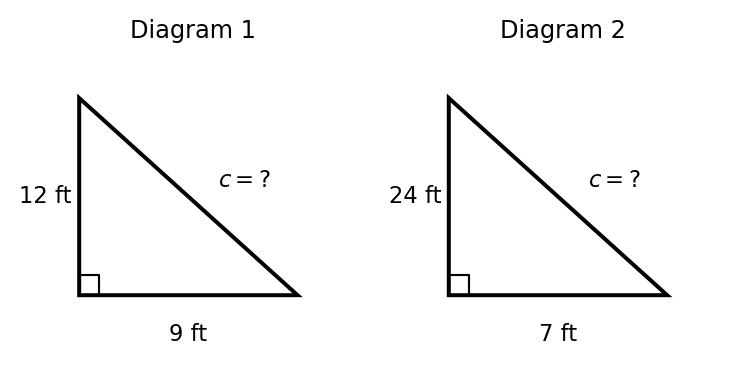
- Find the hypotenuse of the triangle in Diagram 1.
- Find the hypotenuse of the triangle in Diagram 2.
- Hypotenuse: 10 ft. One leg: 6 ft. Find the other leg.
- Hypotenuse: 13 ft. One leg: 5 ft. Find the other leg.
- Legs: 4 ft and 7 ft. Find the hypotenuse. Round to two decimal places.
TipSolutions
\(9^2 + 12^2 = 81 + 144 = 225 = c^2 \Rightarrow c = 15\) ft.
\(7^2 + 24^2 = 49 + 576 = 625 = c^2 \Rightarrow c = 25\) ft.
\(6^2 + b^2 = 10^2 \Rightarrow 36 + b^2 = 100 \Rightarrow b^2 = 64 \Rightarrow b = 8\) ft.
\(5^2 + b^2 = 13^2 \Rightarrow 25 + b^2 = 169 \Rightarrow b^2 = 144 \Rightarrow b = 12\) ft.
\(4^2 + 7^2 = 16 + 49 = 65 = c^2 \Rightarrow c = \sqrt{65} \approx 8.06\) ft.
10.4 Applications
Example 10.9 A house in Taos has a roof with a 12:3 pitch — for every 12 feet of horizontal run, the roof rises 3 feet. The house is 24 feet wide, so each side of the roof has a horizontal run of 12 feet. How long is a rafter on one side of the roof?
The rafter, the rise, and the horizontal run form a right triangle with legs 12 and 3.
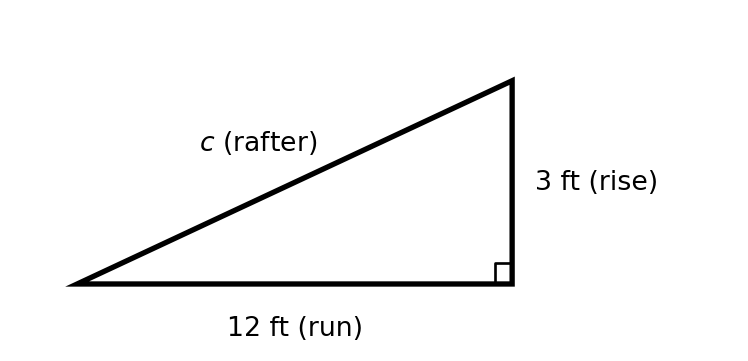
\[\begin{aligned} c^2 &= 12^2 + 3^2 \\[4pt] c^2 &= 144 + 9 = 153 \\[4pt] c &= \sqrt{153} \approx 12.4 \text{ feet.} \end{aligned}\]
Example 10.10 (Activity: Applications)
- A wheelchair ramp at UNM-Taos rises 3 feet over a horizontal distance of 4 feet. How long is the ramp surface?
- A fence runs diagonally across a rectangular lot that is 24 feet wide and 32 feet long. How long is the fence?
- A support wire is attached to the top of a 15-foot antenna and anchored to the ground 9 feet from the base. How long is the wire?
- A hiker near Taos walks 7 miles east and then 7 miles north. How far is the hiker from the starting point? Round to two decimal places.
TipSolutions
\(c^2 = 3^2 + 4^2 = 9 + 16 = 25 \Rightarrow c = 5\) feet.
\(c^2 = 24^2 + 32^2 = 576 + 1024 = 1600 \Rightarrow c = 40\) feet.
\(9^2 + 15^2 = 81 + 225 = 306 \Rightarrow c = \sqrt{306} \approx 17.49\) feet.
\(c^2 = 7^2 + 7^2 = 49 + 49 = 98 \Rightarrow c = \sqrt{98} \approx 9.90\) miles.
10.5 Homework exercises
Exercise 10.1 Find the missing side of each right triangle. Round to two decimal places where needed.
| Leg \(a\) | Leg \(b\) | Hypotenuse \(c\) |
|---|---|---|
| 6 | 8 | |
| 9 | 15 | |
| 40 | 41 | |
| 10 | 10 | |
| 11 | 60 | |
| 20 | 29 |
TipSolutions
Row 1: \(6^2 + 8^2 = 100 \Rightarrow c = 10\).
Row 2: \(9^2 + b^2 = 15^2 \Rightarrow b^2 = 225 - 81 = 144 \Rightarrow b = 12\).
Row 3: \(a^2 + 40^2 = 41^2 \Rightarrow a^2 = 1681 - 1600 = 81 \Rightarrow a = 9\).
Row 4: \(10^2 + 10^2 = 200 \Rightarrow c = \sqrt{200} \approx 14.14\).
Row 5: \(11^2 + 60^2 = 121 + 3600 = 3721 \Rightarrow c = \sqrt{3721} = 61\).
Row 6: \(20^2 + b^2 = 29^2 \Rightarrow b^2 = 841 - 400 = 441 \Rightarrow b = 21\).
Exercise 10.2 For each problem, draw a diagram, identify the right triangle, and solve. Round to two decimal places where needed.
- A 10-foot ladder leans against a wall in Taos. The base of the ladder is 6 feet from the wall. How high up the wall does the ladder reach?
- A rectangular plot at the UNM-Taos campus measures 20 feet by 48 feet. What is the length of the diagonal?
- A rancher near Cimarron stretches a wire from the top of an 8-foot fence post diagonally to the ground. The wire is 10 feet long. How far from the base of the post is the wire anchored?
- Two hikers start from the same point. One walks 5 miles south and the other walks 12 miles east. How far apart are the hikers?
TipSolutions
\(6^2 + h^2 = 10^2 \Rightarrow h^2 = 100 - 36 = 64 \Rightarrow h = 8\) feet.
\(c^2 = 20^2 + 48^2 = 400 + 2304 = 2704 \Rightarrow c = 52\) feet.
\(8^2 + d^2 = 10^2 \Rightarrow d^2 = 100 - 64 = 36 \Rightarrow d = 6\) feet.
\(c^2 = 5^2 + 12^2 = 25 + 144 = 169 \Rightarrow c = 13\) miles.
Exercise 10.3 Challenge: Area of any triangle
The formula \(A = \dfrac{1}{2} B \cdot H\) works for all triangles, not just right triangles — as long as \(H\) is the height, meaning the perpendicular distance from the base to the opposite vertex.
For a right triangle, the legs are already perpendicular, so no extra work is needed. For other triangles, we must find \(H\) by drawing an altitude.
Part 1. The triangle below has base \(B = 10\) and the altitude from the opposite vertex to the base has length \(H = 4\). The foot of the altitude divides the base into segments of length 6 and 4, creating two right triangles.
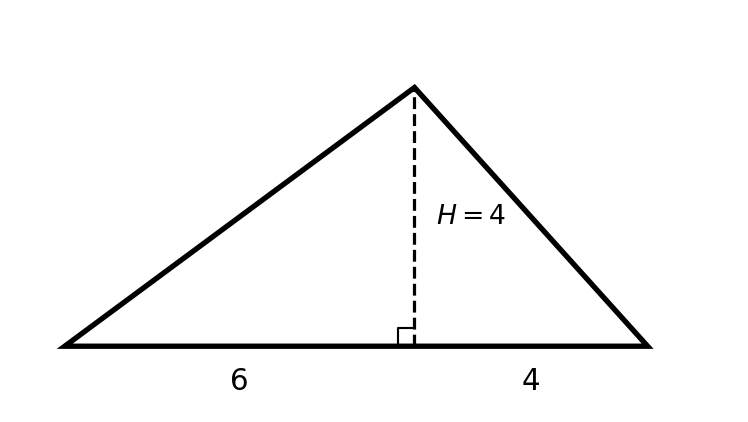
Find the area of each right triangle, then add them to find the total area of the triangle. Does your answer match \(\dfrac{1}{2}(10)(4)\)?
Part 2. Now consider a triangle where the altitude falls outside the base. The figure below shows a triangle with base \(B = 6\). When the altitude of height \(H = 5\) is drawn, its foot falls 2 units beyond the right end of the base, creating a large right triangle (legs 8 and 5) and a small right triangle (legs 2 and 5).
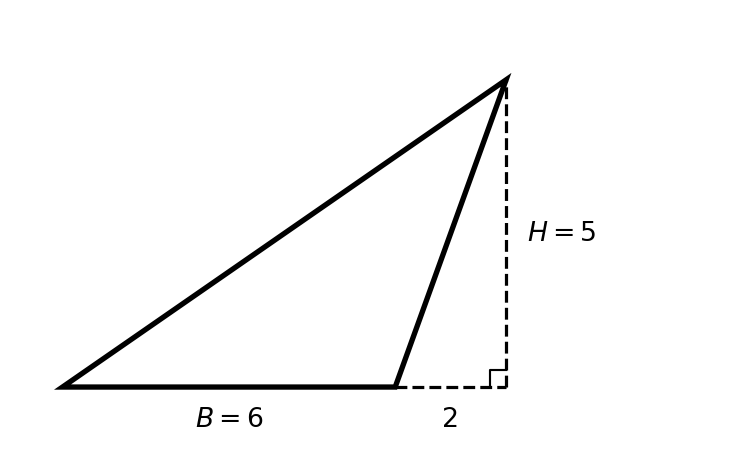
Find the area of each right triangle. Subtract the small from the large to find the area of the original triangle. Does your answer match \(\dfrac{1}{2}(6)(5)\)?
TipSolutions
Part 1. Left right triangle (legs 6 and 4): \(A_1 = \dfrac{1}{2}(6)(4) = 12\). Right right triangle (legs 4 and 4): \(A_2 = \dfrac{1}{2}(4)(4) = 8\). Total: \(12 + 8 = 20\). Check: \(\dfrac{1}{2}(10)(4) = 20\). ✓
Part 2. Large right triangle (legs 8 and 5): \(A_\text{large} = \dfrac{1}{2}(8)(5) = 20\). Small right triangle (legs 2 and 5): \(A_\text{small} = \dfrac{1}{2}(2)(5) = 5\). Triangle area: \(20 - 5 = 15\). Check: \(\dfrac{1}{2}(6)(5) = 15\). ✓